Select movie Search movie Close search My Account

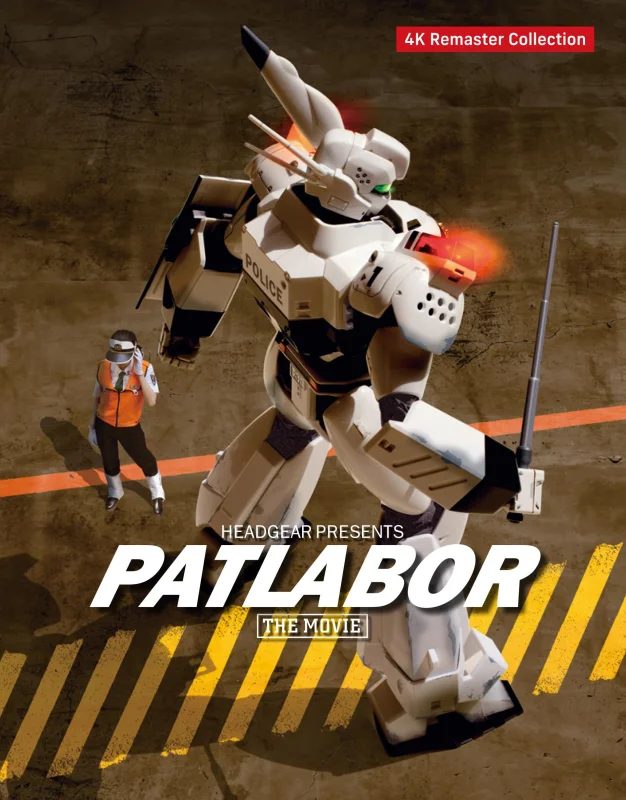
Patlabor: The Movie 4K 1989 Ultra HD 2160p

Patlabor: The Movie 4K 1989 Ultra HD 2160p
BDRemux
Country: Japan
Time: 01:39:05
IMDB: 7.0
Director: Mamoru Oshii
+1
1
Actors: Toshio Furukawa, David Jarvis, Doug Erholtz, Mîna Tominaga, Briony Glassco, Julie Ann Taylor, Ryûsuke Ôbayashi, Peter Marinker, Roger Craig Smith, Yoshiko Sakakibara, Sharon Holm, Megan Hollingshead, Yô Inoue, Tamsin Hollo, Lisa Enochs, Michihiro Ikemizu, Martin McDougall, Sam Riegel

Story Movie

Special robots called Labors were invented for construction work, but criminals adapted them for combat. To cope with the wave of crime, a mobile police force was organized, which uses Patlabors—a police version of construction robots equipped with a revolver cannon and an electric shock baton.


Review 4K Movie

Outwardly, the film is completely commercial. At the same time, it lacks dynamism, the investigation itself is uninteresting, and the science fiction element remains somewhere far beyond the viewer's attention (the finale is nothing more than a typical robot battle). And yet, the film is a real pleasure to watch—the whole point is hidden in a special realistic feeling, the purpose of which is apparently to immerse the viewer in the narrative as deeply as possible. However, this goal is lost—even if the film were called “The Daily Life of a Construction Crew,” it would have the same effect.

Mamoru Oshii deliberately makes the story bland. But he takes pleasure in the details - he literally paints the world. There are so many of them that watching becomes a pleasure: a girl is unhappy that she is being bossed around; in the morning of a working day, police officers discuss the situation; investigators venture into the depths of an abandoned neighborhood to find the residence of a deceased criminal; the boss has a special attitude toward the psychotic programmer, investigating his biography; a subordinate is removed from the case to relieve him of the pressure of obligation and allow him to work on the same case on a flexible schedule. Scene after scene, everything is interesting. Against this everyday backdrop, the light comic/anime grotesque (especially in the form of faces and the emotions reflected in them) works like an armor-piercing weapon. Much stronger than in ordinary anime.

If we compare this attention to detail with another, much more famous “detailer,” Hayao Miyazaki, we can find several fundamental differences.

First, Miyazaki draws details to develop a fictional world. The goal is fantasy. Mamoru Oshii, against the backdrop of a fantasy world, draws a real world, so much so that it overwhelms the fantasy and anime components.
Second, Miyazaki's fictional world is too poetic, in some ways very close to Disney with its musicality of movement. This tendency is clearly visible in Ghibli's non-magical works (for example, Whisper of the Heart), where the realistic context is not developed in any way, but the magical seeps through reality. In Miyazaki's work, the fictional is natural, but not real - this is Tolkien's task of the “green sun.” In Oshii's work, the “natural” component is taken to the point of negating poetry, romance, and mystery, but this is precisely what makes his Patlabor interesting. It is not just about everyday life, but about a perspective where such restrained realism begins to bring pleasure and forces the viewer to observe their own reactions.

I particularly enjoyed the light and color: the shadows on people's faces, the squares of light from the windows, the shades of the sky at different times of the day. The latter allowed me to feel myself in the time of the film - through barely noticeable shades (and sometimes clearly noticeable ones), my subconscious grasped the context of time: evening, morning, day, night, the beginning of twilight.
I didn't focus on it, but I knew what time of day it was. In general, animated worlds often sin either by simply lacking light, color, and time, or by using stereotypical solutions. Things like sun-drenched white walls and sunbeams breaking into a room to the “ringing” of cicadas are not uncommon in anime — but they are solved in a stereotypical, standard way. Evening is typically shown as an orange sunset, and night indoors does not go beyond the black square of the window. For Mamoru Oshii, night is sharp shadows on people's faces, and evening is blue walls and dim lighting (as happens when you haven't yet realized that it's getting dark and haven't turned on the artificial light).

Another problem with anime is its oversaturation with poetry. In Patlabor, there is a feeling that color and light are not being used - you just get a strange, vague pleasure from watching a fantastic action movie in which nothing happens. Glare suddenly running across a moving human body, contexts of evening, morning, and daytime skies, details unnecessary to the plot—first, they are scattered completely randomly throughout the film, and second, they are presented in exactly the same proportion as I might encounter them in life. That is, not in the poor quantity that is characteristic of animation that has forgotten about life, and not in the violent exaggeration that poetic or fairy-tale animation gives. But just enough for me to notice them, or perhaps even miss them altogether.

As a person who is already tired of “beauty,” I must admit that I find this middle ground, where they leave you alone and don't try to dazzle you, where they deliberately refrain from any magic, but count on a light and restrained interest, and made me watch Patlabor with that very special pleasure. The same can be said about the images of abandoned neighborhoods—no matter how saccharine an excess of visual and fairy-tale means Miyazaki would use to describe these views. Mamoru Oshii simply draws abandoned neighborhoods, and nothing else... almost. There is a hint of mystery and poetry in the drawing of the streets. And that is exactly the little bit that you feel when you climb into such a neighborhood in real life.

The theme of Patlabor is a balanced romanticization of realism—anti-magical realism. A touch of grotesque, borrowed from comic book culture, reinforces this feeling. I remember that Tolkien divided readers into those who were enthralled and those who were thoughtful—well, Patlabor is “thoughtful” realism.

Mediainfo

movie Blu-Ray Remux

Video

Codec: HEVC / H.265 (90.1 Mb/s)
Resolution: Native 4K (2160p)
HDR: HDR10
Aspect ratio: 1.85:1
Original aspect ratio: 1.85:1


Audio

#Japanese: Dolby TrueHD 5.1 (48kHz, 24-bit)
#Japanese: Dolby Digital 5.1
#Japanese: FLAC 2.0
#English: DTS-HD Master Audio 5.1
#English: Dolby Digital 5.1


Subtitles

English, Chinese (Cantonese), Chinese (Traditional), Dutch, French, German, Japanese, Spanish (Latin American).

Download

download 4K Blu-Ray movies of MoonDL

download 4K Blu-Ray movies of TakeFile

Once you purchase a premium account on MoonDL or TakeFile, your traffic increases automatically. The following amounts are available on MoonDL:
512 GB every 2 days with Premium Full Moon
128GB every 2 days on Premium Moon.
On TakeFile, the traffic increase also happens immediately after activating your premium account. Enjoy the increased limits without having to contact support!

Watch a movie trailer - Patlabor: The Movie 4K 1989 Ultra HD 2160p
Comments and Feedback
Add your comment:
Your name:
Your E-Mail: