Select movie Search movie Close search My Account

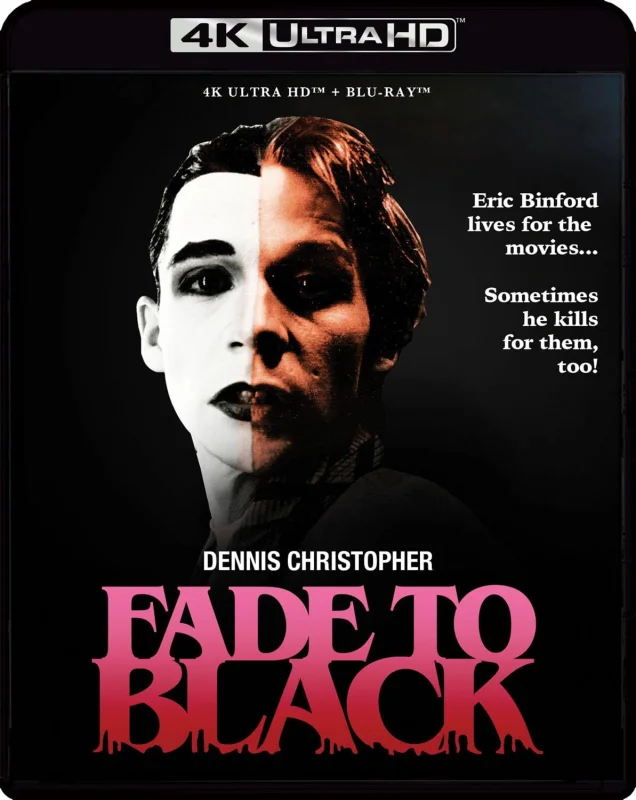
Fade to Black 4K 1980 Ultra HD 2160p

Fade to Black 4K 1980 Ultra HD 2160p
BDRemux
Genre: Comedy 4K , Horror 4K
Country: United States
Time: 01:42:04
IMDB: 6.1
Director: Vernon Zimmerman
0
0
Actors: Dennis Christopher, Tim Thomerson, Gwynne Gilford, Norman Burton, Linda Kerridge, Morgan Paull, James Luisi, Eve Brent, John Steadman, Marcie Barkin, Mickey Rourke, Peter Horton, Hennen Chambers, Melinda O. Fee, Anita Converse, Bob Drew, Teddi Siddall, Sharon Sharth

Story Movie

Eric is a true movie buff. He watches countless films, knows many monologues by heart, recognizes every actor, and is fascinated by scenes from movies. But gradually, he begins to confuse real life with what he sees on screen. He loses his mind and starts reenacting memorable scenes from his favorite movies in real life.


Review 4K Movie

The film’s director and screenwriter, Vernon Zimmerman, incorporated a highly intriguing idea into his work, but failed to develop it effectively. But more on that later.

The plot framework itself is intriguing, as we see a young man who is fanatically in love with classic, remarkable films across many genres. His favorite films, with their charismatic heroes or villains, along with certain scenes he’s watched until they’re worn out, have become so ingrained in his consciousness that he recites celluloid scenes in real life with voice and facial expressions, as if his mind is clouding over, falling into the void between the film and reality. As is quite understandable, this does not lead to anything good—the fragile line disappears, the man goes mad, reenacting in real life a deadly cowboy duel, a vampire’s blood-drinking, a brutal gangster shootout from *Tommy Gun*, and so on. The police begin searching for the maniac…

From these elements emerges an unusual thriller villain who commits a series of murders inspired by famous films, reenacting them for real—without blank cartridges or pointed camera lenses. Moreover, this is not a typical maniac-versus-police story with a detective, since the officers serve merely as background figures, while all attention is initially focused directly on the “victim of cinematic influence”—a man whose childish mind, from an early age, was nourished solely by fictional heroes whose charm is so hard to resist. This becomes the captivating nerve of the film for us, the viewers, as we observe the character’s systematic descent into madness—people who might live somewhere near us, people we ourselves could have become. After all, if you think about it, it wasn’t cinema or legendary actors that turned the young man into a maniac, but loneliness. It was loneliness that fostered a voluntary urge to distance oneself—to flee from reality into the world of cinema; in childhood, with a lack of parental love—only an aunt who was always screaming; and upon reaching adolescence—no girlfriend and no friends, but instead glossy photo-icons of Monroe with cool guys in fedora hats and Prohibition-era coats. As is well known, it is easy to idolize certain conventional images, frozen in a single moment—that same blonde sex symbol with her eternally alluring half-closed eyes and half-parted, moist lips—or to idealize the slick Hollywood stars of the golden age, but try accepting them as real people, just like those around you—and you’ll see that the inability to connect with the outside world beyond the silver screen reveals the main catalyst for madness.

Withdrawn, lonely people in their “shells”—always unpredictable and dangerous because they live so deeply in their fantasies, for so long that one day they may lose touch with reality; moreover, one can’t help but feel a certain pity for them. And the director adheres to this dualism in his story, using broad and subtle strokes of personal and social drama in its construction, exemplified by a young maniac trapped in a vicious cycle of sociopathy—where the world is unpredictable, yet celluloid film follows a strict script— and the more problems there are in reality, the stronger the urge to hide in fiction. Our hero simply has no other consolation.

This, along with the simply entertaining scenes where the viewer (who also loves classic black-and-white multi-genre cinema) can observe a series of reworkings of well-known, familiar shots, contributes to a positive assessment of the film. For example, there is the interesting transformation of a young man into an imitation of Lugosi and Lee’s vampires, or the not-without-irony-staged free adaptation of the shower scene from *Psycho* , where gray ink—rather than vivid, real scarlet blood—runs down the drain, recreating the color-restricted cult film in real life.

However, as mentioned at the very beginning of this text, unfortunately, the director planted a beautiful seed of a timely issue in the soil after the invention of the miracle of cinema, but failed to bring it to fruition. He touched upon a complex issue, attempting to expose the duality of cinematic art to public view, trying to highlight its positive charm—the pleasure derived from the harmonious work of the muses’ servants—while also falling under its influence, often due to a brilliance that overshadows real life, with a montage of everyday and prosaic moments so common in the present. That is, there is a basis for the arguments, there are illustrative scenes, but they are never brought to a common denominator, simplistically merging into the film’s typical denouement—precisely without a resolution of the idea. In my opinion, the climax is far too chaotic and simplistically predictable.

Ultimately, the film is unbalanced in its pacing; it seems to start off well as an interesting, intriguing social drama-thriller, but then loses sight of the complexity of the issue. Still, it’s worth watching for its originality and relevance, and one cannot fail to note the young lead actor, Dennis Christopher, who strives to convincingly portray the complex character of a cinephile-maniac to evoke the audience’s pity, and purely because of his gaunt, haggard, pale appearance, which perfectly fits the role of a man who has been watching three movies a day for years, falling asleep and waking up to them. It’s also a pleasure to see Tim Thomerson in a small role, still without gray hair, and Mickey Rourke, who appears only briefly for now.

Mediainfo

movie Blu-Ray Remux

Video

Codec: HEVC / H.265 (81.8 Mb/s)
Resolution: Native 4K (2160p)
HDR: Dolby Vision, HDR10
Aspect ratio: 1.85:1
Original aspect ratio: 1.85:1


Audio

#English: FLAC 2.0
#English: Dolby Digital 2.0 (Commentary With Film Critic Drew McWeeny)
#English: Dolby Digital 2.0 (Commentary With Actor Dennis Christopher)
#English: Dolby Digital 2.0 (Commentary With The Hysteria Continues)
#English: Dolby Digital 2.0 (Commentary With Film Historians Amanda Reyes And Bill Ackerman)


Subtitles

English.

Download

download 4K Blu-Ray movies of MoonDL

download 4K Blu-Ray movies of TakeFile

Once you purchase a premium account on MoonDL or TakeFile, your traffic increases automatically. The following amounts are available on MoonDL:
512 GB every 2 days with Premium Full Moon
128GB every 2 days on Premium Moon.
On TakeFile, the traffic increase also happens immediately after activating your premium account. Enjoy the increased limits without having to contact support!

Watch a movie trailer - Fade to Black 4K 1980 Ultra HD 2160p
Comments and Feedback
Add your comment:
Your name:
Your E-Mail: